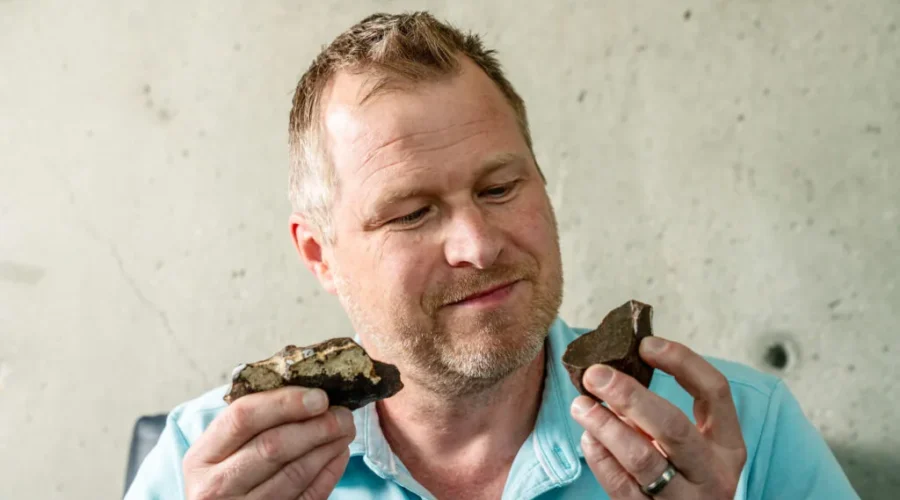
SALT LAKE CITY, UT — A chunk of the Great Salt Lake meteorite is now on public view for the first time at the University of Utah. The 774-gram piece is the largest fragment recovered from the August 2022 event.
The fireball was seen across the Midwest and Mountain States before the meteorite came down on the playa along the lake’s south shore. People across the Salt Lake Valley heard a boom that morning, including university meteorite expert James Karner.
The Fall
Karner said the object was witnessed as it crossed the sky, which makes it a “fall” meteorite. Utah has only one other known fall on record, near Garland in Box Elder County in 1950.
The 2022 event drew attention in real time. A Snowbasin Ski Resort webcam captured the bright streak, and Utah Gov. Spencer Cox said on social media that he heard the boom while out running in Salt Lake City.
The Hunt
Karner, a research associate professor in geology and the U.’s resident meteorite expert, quickly began looking for where the pieces landed. He contacted a colleague at NASA’s Johnson Space Center, who used weather data from Salt Lake City and Pocatello, Idaho, to help confirm the ground impact.
That kind of pinpointing is much easier now than it was two decades ago. Karner said Doppler radar and weather radar can now show the explosion and track meteorites as they fall, allowing researchers to narrow the search area much more precisely.
The Rock
The meteorite was eventually donated to the university by Arizona-based meteorite hunter Robert Ward. Along with the display piece, dozens of other fragments from the same event have been recovered.
Karner said about 3.2 kilograms have been collected so far, and he believes more pieces may still be out there in the playa, the lake bed and nearby salt ponds on the west side of the lake.
The Science
Scientists classified the rock as an ordinary chondrite, a type that makes up about 80% to 85% of meteorites. Its value lies less in rarity and more in the way it was tracked from sky to ground.
By tracing the fireball’s path, researchers were able to work backward to its pre-impact orbit in the asteroid belt. Karner said that kind of link between an asteroid family and a specific meteorite has been made only about 70 times.
On Display
The exhibit opened last week inside the Department of Geology and Geophysics’ main office in the Sutton Building’s second-floor lobby area known as the Confluence. It includes video and interpretive materials explaining the meteorite’s path and recovery.
Karner called the event a once-in-a-lifetime cosmic moment and said the rock is part of Utah’s natural history. He noted that the meteorite is about 4.56 billion years old, far older than dinosaur bones.
Local stories that matter, from Fairmont Flyer.